
What Another Season of Waiting Could Cost You
A garage door that buckles in a windstorm doesn't just mean a broken door. Once wind gets behind a failed garage door, it pressurizes the entire garage, and that pressure has to go somewhere — often through the roof or the wall connecting the garage to the rest of the house. Homeowners who put off a wind inspection for one more season sometimes end up paying for a new door, a new opener, drywall repair, insulation, and in bad cases, roof work, all from a storm that would have done nothing to a door in good condition. The parts that fail are usually cheap to fix ahead of time and expensive to fix after.
Why the Garage Door Is the Weakest Wall in the House
Exterior walls are built as solid, continuous structures. A garage door is not. It's a large panel of thin steel or wood sections, held in place by tracks, rollers, and springs rather than being anchored into the framing the way a wall is. That's the trade-off for having a door big enough to drive a car through. When wind pushes against a house, most walls simply resist it. A garage door has to resist it too, but with far less material and far more moving parts that can bend, pop out of track, or tear loose from their hinges.
This matters more in homes with an attached garage, which is most houses in this area. If the garage door fails first, the wind doesn't stop at the garage — it pressurizes the shared space and pushes on the ceiling, the interior door, and the roof structure from underneath. Retrofitted older homes may have already had seismic bracing added to walls and roof connections, but that bracing does nothing for a garage door that was never built with wind load in mind.
The Specific Risk Here: Santa Ana Winds Followed by Winter Rain
Fall and early winter in the Inland Empire bring Santa Ana wind events — dry, fast-moving gusts that kick up dust and carry wildfire smoke, often with little warning. These winds hit hardest in open, inland areas without coastal buffering, which describes most of the region. Right behind wind season comes winter rain, sometimes arriving as a storm system with its own gusts layered on top of steady wind. A door that's already stressed or slightly misaligned from a fall wind event is in worse shape to handle a winter storm pushing rain and wind at it at the same time.
The combination is what makes this stretch of the year different from summer heat or spring dust. It's not one kind of stress, it's two back to back, and a door only needs to fail once.
Signs Your Door Won't Hold Up
- Tracks that are bent, loose, or slightly out of alignment — even a small gap lets the door shift under pressure instead of staying seated.
- Worn or cracked rollers that no longer move smoothly, putting extra strain on the track during gusts.
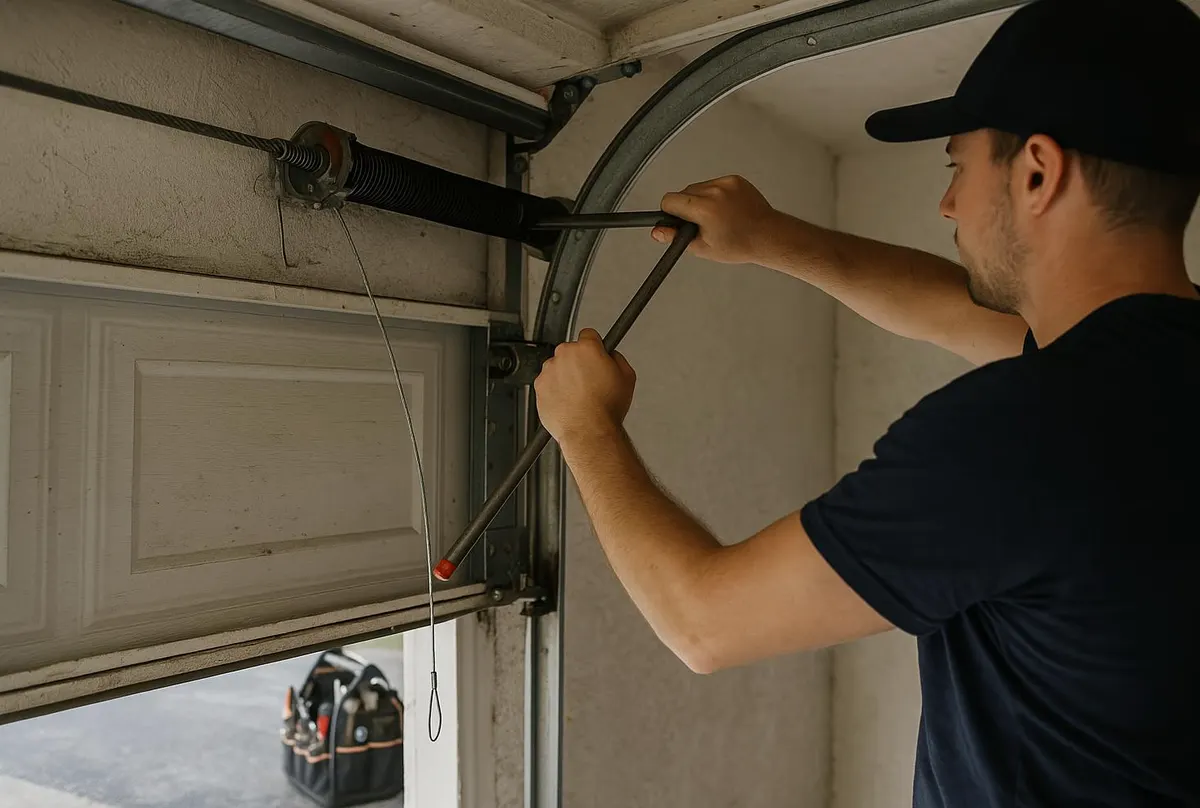
- Springs that look stretched, rusted, or uneven — a weak spring can't hold the door steady when wind is pushing against it.
- Dented or warped panels, which are already weaker than the surrounding steel and tend to fail first.
- An older opener with no reaction to resistance — if the auto-reverse doesn't engage properly, it's also not giving you any early warning that something's wrong with the door's movement.
- Gaps around the weatherstripping that let wind-driven rain in now, which is a preview of how much air a strong gust could push through later.
What to Actually Do Before the Wind Picks Up
Reinforce what's already there
Bracing kits that stiffen the horizontal panels and strengthen the connection between the door and the track can meaningfully improve how a standard door handles gusts, without replacing the whole unit. This is usually the lower-cost option, often in the low hundreds of dollars range depending on door size and material.
Replace what's worn, not just what's broken
Rollers, hinges, and springs are wear items. If they're original to a door that's several years old, replacing them before storm season is cheaper than replacing them after a failure, and it directly addresses the parts most likely to give out under wind load.
Check the opener's response, not just its function
An opener that still opens and closes the door isn't necessarily one that will protect it. Auto-reverse and force-sensing settings should be tested, not assumed. A battery backup is also worth having, since storms and power outages tend to arrive together.
Consider a wind-rated door if you're due for a replacement anyway
If the door is older and due for replacement regardless, a wind-rated or reinforced model costs more upfront than a standard door but is built specifically for the kind of pressure differential described above. For a home with an attached garage in an area that gets both Santa Ana winds and winter storms, that's a reasonable trade-off to weigh against a standard install.
When to Call Ontario Garage Door
If your door is showing worn rollers, uneven springs, or track misalignment, that's a job for Garage Door Maintenance before storm season starts, not after a gust finds the weak point for you. If a spring looks stretched or has already failed, Spring Replacement should happen promptly — a weak spring under wind load is one of the fastest ways to lose control of the door entirely. We'll inspect the track, rollers, springs, panels, and opener response, and tell you plainly whether reinforcement is enough or whether replacement makes more sense for your situation.
Call Ontario Garage Door before this year's wind and rain arrive. We serve Ontario, Rancho Cucamonga, Upland, Fontana, Montclair, Pomona, Chino, and Claremont, and we'd rather inspect your door now than repair it after a storm.